Fire Watch Guards Are Saving Lives — Is Yours Protected?
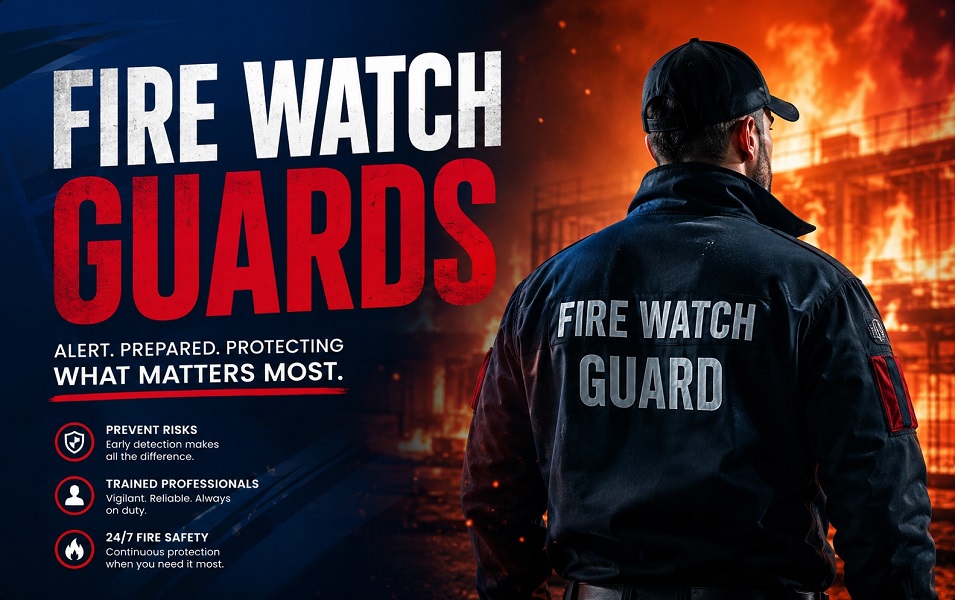
The smoke alarm went off at 2:47 a.m. inside a high-rise under renovation in downtown Chicago. The sprinkler system had been offline for three days. What stood between a smoldering electrical wire and a catastrophic loss of life wasn’t technology — it was a trained human being walking the floor with a flashlight, a radio, and a protocol. Fire watch guards are not a relic of pre-modern safety infrastructure. They are, in fact, the last line of defense when every other system fails.
That story plays out more often than most property owners or facility managers want to admit.
When the System Goes Dark, Humans Step In
Fire alarm systems fail. Sprinkler networks go offline for maintenance, upgrades, or storm damage. Construction and hot work — welding, cutting, grinding — create combustion risks that automated systems weren’t designed to catch in real time. These are the moments when trained fire watch professionals become irreplaceable.
A certified fire watch guard operates as a human fire detection system. They walk assigned patrol routes continuously, using sight, sound, and smell to detect signs of smoke, heat, or flame. If a hazard is identified, the protocol is immediate: alert occupants, call 911, and execute evacuation procedures. There’s no algorithm involved. There’s no network latency. There’s a trained professional making a real-time decision that can save dozens of lives in a matter of minutes.
This is precisely why companies like Just Fire Watch have built an entire business model around rapid deployment — positioning certified guards on-site within hours of a call, not days.
The Legal Reality Most Business Owners Ignore
Here’s what keeps fire safety attorneys busy: most property managers don’t realize that fire watch coverage isn’t optional — it’s legally mandated under specific conditions.
The National Fire Protection Association (NFPA), particularly NFPA 101 (Life Safety Code) and NFPA 25, requires fire watch services whenever fire suppression or detection systems are taken out of service for more than four hours in a 24-hour period. Local fire codes across major U.S. cities mirror and often exceed these federal guidelines. When a fire marshal shows up for an inspection and finds an impaired system without an active fire watch in place, the consequences are swift and costly.
Penalties can include significant fines, forced business closures, and — most damaging — catastrophic legal liability if a fire occurs during the period of non-compliance. Insurance companies are watching, too. A fire damage claim filed after a period of documented system failure, without evidence of a fire watch, can be denied entirely. The financial exposure for building owners in that scenario is enormous.
What These Guards Actually Do — Beyond the Patrol
The popular image of a security guard sitting at a desk with a cup of coffee doesn’t apply here. Fire watch professionals operate under a strict, documented duty structure that most people outside the industry have never seen.
Every patrol is logged. Time-stamped entries note the condition of each area, the status of exits, the presence of hazardous materials, and any anomalies detected. These logs are not internal paperwork — they are legal records, often required by fire departments and insurance providers to verify that continuous surveillance was maintained. Guards are also trained to identify secondary risks: blocked emergency exits, compromised fire doors, improperly stored flammables, and malfunctioning emergency lighting.
Beyond detection, many certified fire watch personnel are trained in the RACE protocol — Rescue, Alarm, Confine, Evacuate — which mirrors the emergency response framework used by hospital safety teams and industrial facility managers. When seconds matter, a guard who knows exactly what to do next isn’t a luxury. It’s a necessity.
The Industries Driving Demand
Demand for professional fire watch services has risen sharply across several high-risk sectors, and the reasons are both structural and regulatory.
Construction is the most obvious driver. Any active construction site running hot work operations — welding, torch cutting, grinding — is required under OSHA guidelines to have a qualified fire watch present during the work and for a minimum of 30 minutes after operations cease. A spark that appears extinguished can smolder in insulation, drywall, or wooden framing for hours before igniting. The fire watch guard is the only safeguard against that delayed ignition.
Healthcare facilities present a different challenge. Hospitals and long-term care centers operate under strict Joint Commission accreditation standards, and any lapse in fire protection coverage must be met with an immediate fire watch response. Patient evacuation in a healthcare environment is extraordinarily complex — the guards stationed in these facilities often work directly alongside clinical staff to ensure routes are clear and protocols are understood.
Hospitality and entertainment venues — hotels, concert halls, sports arenas — face elevated risk during large events where sprinkler system maintenance may coincide with maximum occupancy. In these settings, fire watch guards become crowd safety assets, not just hazard monitors.
The Cost Equation Nobody Talks About
There’s a persistent misconception in commercial real estate and facility management that hiring fire watch guards is an expensive burden — a cost center with no return. That thinking evaporates the moment you run the actual numbers.
The average cost of a commercial fire in the United States runs into hundreds of thousands of dollars when accounting for structural damage, inventory loss, business interruption, and legal exposure. Comprehensive fire watch coverage, by contrast, typically costs a fraction of that — often ranging from a few hundred to a few thousand dollars per day depending on facility size and coverage requirements. The math is not complicated.
What’s more, proactive fire watch coverage can actually lower insurance premiums. Carriers that see documented fire watch logs as part of a property’s safety record view the client as a lower risk. Over time, that translates into measurable savings on annual premiums — turning what looks like an operational cost into a financial hedge.
Not All Fire Watch Services Are Created Equal
As demand has grown, so has the market — and with it, a range of providers whose qualifications vary dramatically. Choosing the wrong fire watch company is not just a compliance risk; it can be a life-safety failure.
The critical differentiators are certification, speed, and accountability. Guards must be licensed in accordance with state-specific security regulations, trained in fire hazard identification, and familiar with the specific fire code requirements of the jurisdiction where they’re deployed. Deployment speed matters equally — a provider who can’t get boots on the ground within a few hours of system failure is not equipped for the emergency nature of the work.
Just Fire Watch, operating under a firefighter-run model, has positioned its service around exactly these standards: rapid nationwide deployment, certified personnel, and a focus on the operational detail that separates a professional fire watch from a warm body holding a clipboard.
The Human Element That Technology Can’t Replace
Artificial intelligence is reshaping security in remarkable ways. Smart cameras now detect motion anomalies. Sensor networks can monitor temperature changes across a building in real time. And yet, even the most sophisticated building management systems carry a fundamental limitation: they depend on the infrastructure they’re designed to protect.
When that infrastructure fails — and it does fail — a trained fire watch guard becomes the most reliable safety asset on the property. They don’t need a network connection. They don’t require a power source to function. They bring judgment, adaptability, and the kind of situational awareness that no sensor array can replicate.
There’s something worth sitting with in that reality. In an era that has automated nearly everything, the protection of human life at its most vulnerable moment still comes down to another human being paying attention.
The question isn’t whether fire watch services are worth the investment. The question is whether your building, your tenants, and your business can afford to go without them.